China Top Car AC Condenser Fan Manufacturers?
Selecting China’s leading car AC condenser fan manufacturers requires more than comparing catalog prices. Buyers need to assess airflow, noise, motor life, sealing, and fit across specific vehicle platforms. A fan that looks suitable on a specification sheet may struggle in a hot, slow-moving traffic queue. Small details matter.
The market backdrop is changing. The International Energy Agency’s Global EV Outlook 2024 reports that nearly 14 million electric cars were sold worldwide in 2023, about 18% of total car sales. That shift increases attention to efficient thermal management, although the report does not separately measure condenser-fan demand. IEA Executive Director Fatih Birol said, “The clean energy transition is happening worldwide, and it’s unstoppable. It’s not a question of ‘if’, it’s just a matter of ‘how soon’—and the sooner, the better for us all.” The quote concerns the broader transition, not condenser fans specifically.
This guide examines China’s Ac Condenser Fan Car suppliers through practical selection criteria: product range, manufacturing capability, quality controls, customization, and export support. Look for clear test records and traceable specifications, not just confident sales language. Ask how suppliers validate airflow and durability under heat and vibration. Then compare samples against the vehicle’s actual fitment requirements. One limitation deserves attention: public reports rarely isolate this product category, so broad market figures cannot confirm an individual factory’s performance. A careful shortlist is useful. Verification still matters.
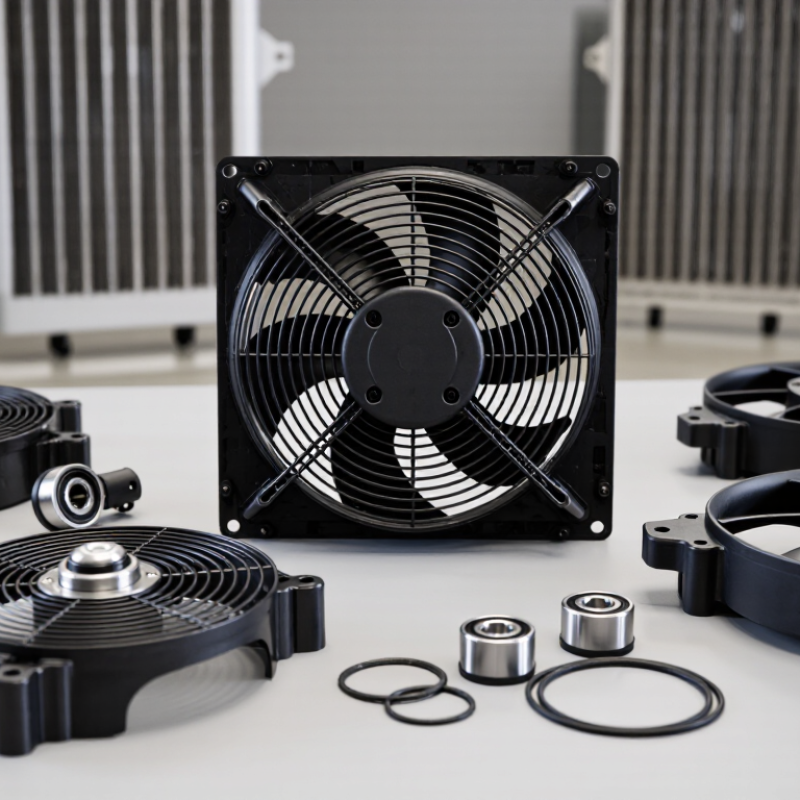
Understanding the Role of Car AC Condenser Fans
A car AC condenser fan moves air across the condenser, where refrigerant releases heat after leaving the compressor. This airflow helps the refrigerant cool and change back into a liquid before it returns through the system. At low speeds or while parked, natural airflow is limited, so the fan becomes especially important. That matters.
On a hot afternoon, a driver may notice weaker cooling while waiting at a traffic light, then colder air once the car is moving. A condenser fan problem can cause this pattern, but it is not proof of a failed fan. Refrigerant levels, electrical connections, and other parts can also affect cooling. A technician can check whether the fan starts, spins steadily, and responds to the system’s temperature demands. Some vehicles use variable-speed fans, so sound alone may not reveal a fault.
Dust or leaves near the condenser can restrict airflow, though cleaning should be gentle because the fins bend easily. Fan noise, vibration, or repeated overheating deserves attention. The fan is a small component with a demanding job; still, replacing it without testing may miss the real cause.

China’s Car AC Condenser Fan Manufacturing Landscape
China’s car AC condenser fan manufacturing landscape is supported by a wide network of component makers, assembly plants, and testing facilities. Many suppliers produce fan motors, blades, shrouds, or complete fan modules. These parts help move air through the condenser, especially when a vehicle is idling or travelling slowly. Small design differences can affect airflow, noise, power use, and installation fit.
Production capability varies. Some factories focus on high-volume standard assemblies, while others handle custom dimensions and vehicle-specific requirements. Buyers should look beyond catalogue claims and ask how airflow, current draw, vibration, and noise are measured. Testing under heat, moisture, and repeated operation also matters. Details matter. A well-finished housing and balanced blade may reduce unwanted vibration, but performance still depends on the whole assembly and the vehicle’s cooling layout.
The supply base can offer flexible lead times and a broad choice of specifications, yet consistency deserves close attention. Samples, inspection records, and clear drawings help confirm that a quoted product matches production parts. A catalogue can look complete, while a small connector or mounting difference causes delays. That gap matters. Manufacturers and buyers both benefit from realistic validation rather than assuming every listed model is ready for every application.
China’s Car AC Condenser Fan Manufacturing Landscape
China’s annual vehicle production provides context for the domestic automotive supply chain and potential demand for components such as condenser fans.
China vehicle production, 2019–2023 (million vehicles). This is a demand-context indicator, not condenser fan production data. Source: China Association of Automobile Manufacturers (CAAM).
Leading Chinese Manufacturers and Their Capabilities
Chinese manufacturers of car AC condenser fans offer capabilities ranging from motor and impeller production to complete fan-module assembly. Established factories may use injection-molded housings, automated winding equipment, and balancing machines to control vibration. Small details matter. Blade pitch, motor current, and mounting-hole position can affect airflow and installation.
Many suppliers can adapt fan dimensions, connectors, and motor specifications to a vehicle program. Their engineering teams may review drawings, build prototypes, and test airflow, noise, vibration, and temperature performance. Ask for test conditions and measured results, not just a pass statement. A polished sample is not proof of consistent production. One gap worth checking is how closely sample testing matches routine line inspection.
Manufacturing strength also depends on process control. Look for documented incoming-material checks, batch traceability, and clear records for motor and fan testing. These details help buyers compare suppliers beyond price and stated capacity. Some factories provide useful technical data, while others need more prompting. That difference matters. Request production samples and confirm that key dimensions, electrical readings, and airflow remain consistent across units.
| Capability Area | Relevant Product or Process Details | What to Verify When Evaluating a Supplier |
|---|---|---|
| This is a supplier-evaluation guide, not a ranking of named companies. Requirements vary by vehicle platform and application; confirm specifications against the relevant drawing and customer requirements. | ||
| Fan assembly design | A condenser fan assembly commonly combines an electric motor, impeller, shroud, and electrical connection. The assembly must fit the vehicle’s available mounting space and airflow path. | Request dimensional drawings, mounting-point details, connector information, and design-change controls. |
| Motor technology | Automotive cooling fans may use brushed or brushless DC motors. The correct motor depends on the vehicle electrical system, control strategy, durability target, and cost requirements. | Confirm motor type, rated voltage, control method, current draw, speed range, and protection features for the specific part number. |
| Airflow and pressure performance | Fan performance is assessed using airflow and static-pressure data. Airflow changes with system resistance, so a free-air figure alone does not describe performance in the installed vehicle. | Request airflow-versus-static-pressure curves, test conditions, rotational speed, and test setup for the proposed assembly. |
| Noise and vibration | Impeller geometry, motor operation, balance, and mounting can affect acoustic noise and vibration. | Review the supplier’s measurement method, test conditions, acceptance limits, and vibration or impeller-balance records. |
| Impeller and shroud production | Injection molding is commonly used for automotive plastic fan components. Material choice and component geometry must suit the specified thermal and mechanical conditions. | Check material specifications, mold-control procedures, dimensional inspection plans, and traceability of production changes. |
| Electrical and end-of-line testing | Production checks can include electrical continuity, operating current, rotational direction, speed, and basic functional operation. | Ask which checks are performed on every assembly, what limits are applied, and how failed units and test records are controlled. |
| Environmental validation | Road-vehicle electrical and environmental test planning can refer to ISO 16750. Applicable tests depend on the component location and vehicle-level requirements. | Request a test plan and reports for the agreed operating environment; confirm the applicable editions and customer-specific requirements. |
| Water and dust protection | ISO 20653 describes degrees of protection for road-vehicle electrical equipment, including protection against access, foreign objects, and water. | Confirm the required IP code, test conditions, and whether the test applies to the motor, connector, or complete assembly. |
| Corrosion testing | ISO 9227 specifies neutral salt-spray, acetic-acid salt-spray, and copper-accelerated acetic-acid salt-spray test methods. | Verify which method and duration are required by the customer; a salt-spray result does not by itself establish vehicle service life. |
| Automotive quality management | IATF 16949 is a quality management system standard for the automotive production and relevant service-part organization context. | Check certificate validity, site and scope coverage, and the supplier’s processes for corrective action, change management, and production traceability. |
| Production capacity and delivery | Capacity depends on the production line, tooling, shift pattern, product mix, and component supply chain; it cannot be inferred from a general product description. | Request capacity assumptions, lead times, tooling ownership terms, contingency plans, and evidence that the quoted output has been validated. |
How to Compare Manufacturers by Quality and Certifications
When comparing car AC condenser fan manufacturers in China, judge the production process, not only quoted price or sample appearance. A fan may look clean on a bench and still vibrate after hours of heat and road dust. Looks can mislead. Ask how suppliers control motor winding, blade balance, housing dimensions, and connector fit. Request inspection records tied to actual batches, not a generic quality statement.
Certifications are useful, but only when their scope matches the product and factory. Check the certificate holder, issuing body, validity dates, covered site, and relevant product category. Then compare those claims with test reports for airflow, current draw, noise, temperature cycling, and vibration. Ask whether tests use your required voltage and mounting position. Details matter. A certificate cannot replace a real sample evaluation, and a test report from an unrelated model offers limited reassurance.
For stronger evidence, request a sample, agreed acceptance criteria, and a written process for handling defects. Review traceability labels and ask how the supplier separates approved parts from rework. If possible, observe a production or inspection step, even through a live video call. Some factories may answer slowly or provide uneven records; that is a signal to investigate, not an automatic verdict. I would also document open questions, because specifications often leave small gaps around connectors or fit. Those gaps can become expensive later.
Key Factors for Choosing a Chinese Condenser Fan Supplier
A reliable Chinese condenser fan supplier should prove performance under the conditions your vehicle actually faces. Request airflow and static-pressure curves, current draw across the voltage range, noise readings, and temperature and vibration test results. A fan that moves air well on an open bench may perform differently behind a condenser. Small details matter. Check connector sealing, mounting tolerances, blade balance, material specifications, and lot-level traceability. Ask how engineering changes are documented, too; this step is easy to overlook when a sample fits perfectly.
The International Energy Agency’s Global EV Outlook 2024 reports nearly 14 million electric cars sold worldwide in 2023, about 18% of car sales. That shift makes electrical load, low-speed cooling, and acoustic performance increasingly relevant selection criteria. Compare suppliers using the same test conditions, not just headline airflow figures. I would not treat one successful prototype as proof of production consistency. Review endurance and environmental validation records, and confirm whether the supplier can reproduce results across multiple production lots. A clear, complete test report is more useful than a polished promise.